My $5 thrift store uke needs a home. I’m in the process of building a case that will include salvaged sleep machine to provide relaxing surf backgorund while playing. I may also include a amp and piezeo pickup for the uke. I’ve constructed the case from scrap poplar and a masonite like stock salvaged from a particle board computer desk. I’ll use contact cement to apply a fabric cover to the case.
Category Archives: project
Retro MP3 player
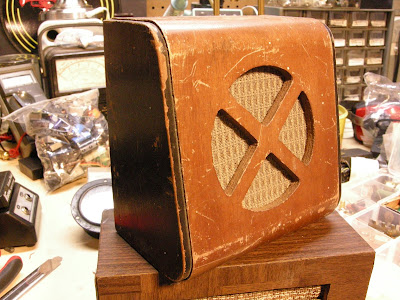
Here’s the concept – I found a great speaker enclosure at ham fest, it’s dying to gain new life as a bedside mp3 player. Think old radio with a 2 gig aesthetic play list to lull someone to sleep. Old radio broadcasts intertwined with simple jazz and classical selections segue with radio tuning and static pushed through a 50 year old 3″ speaker to mask the digital to analog converter and solid state amp in the $10 2gig mp3 player purchased from Microcenter. The rub lies in the interface, I’ve already dissected the mp3 player and I want to use old school toggle switches to navigate, no display needed just play, next track, maybe a folder jump switch. Volume via old school potentiometer, Switches no problem, soldering to the tiny contacts in the thumb sized device will be a bit tricky. Stay tuned.
Another Project Idea…
Guitar building is a great winter activity, I’m probably going to file this one away until it gets chilly out.
Lapsteel guitars are cool low-fi rockstar stuff, combined with the cool Ouija graphics I think it has the potential to be a great furniture guitar cool item. Here’s an image found online that will serve as inspiration:
I started research, scale refers to the length between the bridge and nut. I’ll be building the standard 22.5″
lots of other info here
http://www.bluestemstrings.com/page5.html
Build a 4 terabyte raid 5 nas for under $400!!!!
Here’s a quick and practical project completed across three days. I spent the majority of my time researching and ordering hardware.
.
Build a 4 what with a huu……. Ok – if you don’t speak geek it translates to “build your own secure file storage system for under $400” A comparable ready made box that does the same thing costs between $1000 – $1800. Cool, thrifty and green because it allows you to use a old pc that would have been destined for a landfill.
Storage is always an issue with a photography business and a passion for media. I’ve been reading about freenas a freebsd based operating system that can give that old pc sitting in the corner new life as a nas (network attached storage) it’s basically a computer that runs headless (no monitor or keyboard/mouse attached) and when connected to your home network gives you a boatload of safe data storage. The system uses software raid 5 (redundant array of independent disks) that saves data across 4 drives so if one fails the other three can rebuild it’s contents. No lost files if a hard drive crashes!
Construction was strait forward. I disassembled an old pc that had been sitting in the attic since we had moved in 4 years ago. After a bit of dusting I moved the motherboard to a new case, insalled case fans, nic, dvd-rom and the cf card as the primary hard drive. I booted freenas from the dvd-rom and transferred it to the cf “hard drive”. The next step was to install the sata controller and mount the 4 hard drives. At this point the hardware end was finished and the rest of the configuration is completed across the network with a html interface. Very cool stuff.
here’s my hardware list:
ATX case $0
celeron 700 cpu $0
256mb ram $0
128mb cf card $0
freenas os $0
ide to cf adapter $11.99
syba pci serial ata host card $31.99
10cm case fan $7.99
sata power adapter cable adapter $2.99 x4
18″ sata data cable $4.99 x2
samsung 3.5″ 1tb sata hd $79.00 x4
all this for a grand total of $393.87 !!!
More in the mix
Flea Market Finds
A Few Studio Pics of the tc-10
Note To Self
As the guitar part of this project is wrapping up, I wanted to reflect on a few things I’ve learned through the process.
1. Test on scrap. And have scrap to test ON! I should have started a couple of sanded and sealed boards to test finishes and relic techniques before I worked on the body itself.
2. My biggest mistake of the project was allowing water to seep into the edge of the control cavity route and screw holes during my first round of wet sanding. The wood swelled and created a flat spot in the finish. Way too much water, and I let it sit around the edges. I need to make sure I really hit the routes with primer early on. I also learned to re-wet constantly to keep the sandpaper from clogging. I also saw a guy using a 2 litre bottle cap as a sanding block and this worked very well for the edges
3. With the decal process I used too much gold gel ink and mod podge, this added material made it dificult to get a firm flat seal on the headstock. Thin is the way to go.
4. Spray thin coats, Color was fairly forgiving, but the tinted laquer would show even the tiniest overlap or run.
5. I’ve been looking at alot of old guitars and the stereotypical relic guitar wear isn’t that consistant with alot of the old gear I’ve seen. Very few of the late 50s and 60s strats seem to have extensive forearm wear. Alot of edges wear but this seems to be due to a buildup of dents and dings on the rounded edges that allow larger sections to break away.
6. The direct acid etch process on hardware is way too heavy for a “real” relic look. I like the effect, but it’s not really an authentic effect. An indirect method using muratic acid in a closed container looks 100 times better than the results I achived. Took at http://www.relicdeluxe.com/ for some great relic techniques.
7. The more visulazation and planning I do before I start, the fewer mistakes I make.
Almost Done
Toner Transfer
UPDATE: I started this project with the intention of transplanting a pignose practice amp into this case. A whole new world of options has opened up since I started playing with tubes. I’m putting this one on hold until I find the perfect circuit for this cool combo.
Here’s my first attempt at toner transfer. The inkjet paper has several layers that need to soften in water and peel away from the surface leaving only toner and brass. I think I used too much heat and fused a thick plastic layer with the paper on the face of the page, this caused allot of the toner to pull off with the paper. I also might need to let the piece soak longer.
As long as I can keep the detail around the art I should be ok. I can manually retouch the edges with paint. I will try again today.