All posts by mrfitzer

Round and Round

I made a sketch of the tuners and then broke them down so I could start the hardware relic process. I placed all of the small hardware into a small rock tumbler with a handful of stones and let it bounce around for about two hours. Unfortunately the control plate wouldn’t fit so it looks like I’ll be doing that one manually with a coffee can.

I did a test on the body of the shown tuner with etchant and it knocked the shine off rather well, compare it to the shiny but scuffed appearance on the top of the peg. The green cast on the bridge and the side of the tuner is from a computer monitor. Click on the image above for a BIG view.

As my research has continued I found a wonderful site relicdeluxe.com This site is indispensable for creating a relic instrument.

Teardown

After everything was together and working correctly I started the process of tearing it back apart. I re tasked a flip top plastic organizer to keep all of the hardware organized and dissembled to individual components.

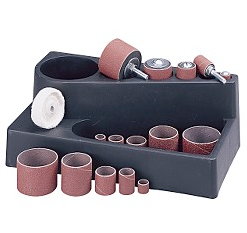
Thinking ahead to reshaping the headstock, I picked up a 21pc drum sanding kit at sears hardware for 15.99.


T
he next step will be to start adding about 50 years of wear to the metal hardware.

The Saga Begins

The kit arrived well packaged with parts in divided bags. I was mocked by several coworkers who had seen the package in the office and popped into my lab and made bad air guitar moves telling me it was a long way to the top if I want to rock and roll (I was mildly impressed with the AC/DC reference)

With the kit safely home I unpacked the kit using a plastic parts tray to sort the hardware. Following the advise of most Saga builders I decided to assemble the kit before starting the
finishing process. This took the better part of three hours. The guitar went together quickly. The neck fit the pocket in the body beautify. The pick guard is out of alignment by a few millimeters but this is being replaced anyways. I ran into trouble when I tool a closer look at the electronics on the control plate.

I think it was someones first day at the saga factory:

A redundant ground wire was running from the from the volume pot to the tone pot that popped off with the first touch. Snip

A black mystery connector (another ground) had no corresponding wire from the pickup cavity. I thought this was a ground for the bridge but there was another one correctly labeled. Snip

Connections have a bullet style connector and a section of heat shrink tubing, but the ground from the pickups would have required an adapter to accept two bullet connectors. Snip

The last straw was the three way switch that was wired incorrectly the joints looked cold (dull and pitted as did all of the connections for that matter) and the leads from the pickups didn’t bridge the two terminals on each side of the switch. At this point I decided to get out my soldapult and tear all of the connections down and start over. This added about an hour but the guitar sounded 10 times better after I was done.

Don’t get me wrong I’m not complaining at all! I have no idea how this kit can be sold this inexpensively. I was expecting two pots, a cap, switch, jack and a coil of wire in the nicely divided bags containing the other parts. I’m sure saga would have also included a small coil of solder.

I strung the guitar up with the included strings and started the setup process. I dropped the saddle height to get things in the right ballpark, the neck looks great right out of the box. I made quick work of the setup with the exception of the a small problem with the E and A saddle. Intonation on the E and A strings are still a little sharp and I’ll have to cut the tension spring down a bit so I’ll have the clearance to pull the saddle back a few millimeters.

I spent a few minutes adjusting pickup height, and got a decent balance between the bridge and neck output level. Clearance on the neck pickup might be a problem if you really layed into the guitar but I’m usually not a heavy handed player.

Waiting for the TC-10 to arrive!

I’m eager to star the project, but I’m committed to taking an appropriate amount of time to do things correctly. In my case this means slow! I’ve jumped into research and design, heres some of what I’ve produced:

Design:

I decided to mock up the look I’m going for in photoshop (the base image is from fenders website, I photoshoped the pickgaurd). I landed on a fiesta red(ish) color, an lp pickgaurd that I saw online a while ago and reliced edges and hardware. I’ll cut the saga headstock to as much a tele shape as possible. Ironically I was having a hard time finding a good pattern image online and then I looked at the licensing agreement between marmoth and fender and it has a great tele headstock drawing in the PDF! I plan on using the stock hardware with the exception of new tuners and brass saddles in the bridge.

Logo:

I liked the angry angus logo. It honest in it’s appearance. I landed in between with my first name, Franz, in a Fender script. I used illustrator to create the graphic working from a photo of a tele headstock. I traced the F, moved the r, scalped the d to make an a, moved the n, and constructed a z by tracing a script font and “fendering” the edges to make it fit the design. It’s shown above in the header graphic, it’s a little rough but I think I have the right idea in place.

Research:

I started with the relic process, I found a great tutorial on youtube from howaudio.com and I took the $20 plunge to subscribe for a month to see the complete tutorial. Youtube also had several other relic tutorials that ranged in quality. HowAudio also had a good series on basic guitar setup.

GuitarAttack has several pages dedicated to TC-10 builds and I’ve started reading them picking up details on assembling the kit.

James Egold wrote a great artice in the September 2008 Premiere Guitar on building a Esquire clone “on the cheap” I found this article very helpful.

Heres a great site with info on fender finishes and custom colors.

Finishing is going to be a challenge. Fortunately I teach in a vocational high school and our auto body instructor is a wealth of knowledge. He was actually working on a cracked finish on a car when I went to ask him about technique for checking a nitrocellulose finish. Needless to say I’ll be talking with Mr. Holley in the future. I’m going to get a jumpstart searching youtube for a quick finishing “primer” pun intended.

I want to build a guitar!

Why Build a Relic?

Two events inspired the construction of the TC-10. I stopped by my local music store, swampdog music and I played an angry angus tele. This guitar knocked my socks off, it was a new guitar but it looked felt and sounded old, with a gorgeous checked nitrocellulose finish and heavily worn edges. The only down side was the $1500 price tag. I believe that it’s worth every penny I just can’t find room in the budget.

I’d recently read an article about Eddie Van Halen and the process he’s gone through modifying his equipment over the years. I really like the concept of playing a role in the creation of the instrument you play. The Angry Angus experience and the EVH article spun into the idea of building a guitar and an amplifier.

What Type of Guitar?

My taste in guitars goes back to 1985 when I saved lawn mowing money for a summer and bought a well used 74 tele custom from Williams music in Worthington, Ohio. At the time neon color guitars and big hair were all the rage and the tele was a steal at around $350 with case. This was my first real guitar. I spent countless hours studying the battle scars on the old guitar and even adding some of my own. A relic tele was an easy choice.

Side note: Premiere Guitar recently featured a fender custom shop “telemaster” Jazzmaster body with a tele neck and tele style electronics. That is a cool guitar, but I decided the first venture should be low budget.

I priced parts on warmoth.com and I decided that I wanted to start with a less expensive option. I wanted to develop technique with something cheap where I could experiment a little. Google lead me to guitar attack and I found the TC-10 kit from Saga. I bought it now on eBay for $120 shipped and I’ve been continuing the research waiting for it to arrive.

A Very Rough Weekend

Ok… I eat allot of racy food. I’m not afraid of a rare steak, sushi, I’ve eaten 4 dozen oysters on the half shell in the past month (none over the past week) It was a Philly cheese steak and fries that got me. Out of commission all weekend. After about ten rounds in the porcelain ring I was left with almost 24 additional hours of sweaty chills. Euch…. food poisoning sucks. On the bright side I would have been heartbroken if it would have been a favorite food, it took a friend over a year before they could stare a dragon roll in the eye after a bad sushi experience.

I’ve been doing well getting my exercise back on track – barring this weekend. I have 15 miles on the new treadmill and I think it’s level and running smooth. I’m banking a few calories for this tasty looking dish:

Blue Cheesecake

Serves 12 to 16
Ingredients:1-1/2 cups water1/2 cup medium-grind cornmeal1 tablespoon chopped garlic1 tablespoon dried basil, crumbled (optional)1-1/2 teaspoons herbes de Provence, crumbled1-1/2 teaspoons kosher salt Three 8-ounce packages cream cheese, at room temperature1/2 pound Oregon Blue Vein, Oregonzola, Gorgonzola, Roquefort, or other high-quality blue cheese, cut into chunks, at room temperature 3 large eggs1/4 cup (1 ounce) freshly shredded Parmesan cheese1 head garlic, cloves separated and roasted (See Cook’s Hint, below)1/2 cup whole hazelnuts, pine nuts, or almonds, toasted Crostini or crackers, for serving, optional

Directions:1. Bring the water to a boil in a small saucepan. Slowly stir in the cornmeal, stirring in one direction to avoid lumps, then add the garlic, basil (if using), herbes de Provence, and salt. Reduce the heat to a simmer and cook until smooth and creamy, stirring occasionally and adjusting the heat as necessary so the polenta doesn’t overcook or bubble up and splatter, 12 to 15 minutes.
2. While the polenta is cooking, place the cream cheese and blue cheese in a large mixing bowl. Add the eggs one at a time and mix by hand (if you are very strong!) or beat with an electric mixer until the eggs are thoroughly incorporated. Set aside.
3. Arrange the oven rack in the center of the oven. Preheat the oven to 325 degrees F. Lightly oil a 9-inch springform pan or spray with nonstick cooking spray.
4. When the polenta is done, remove it from the heat and stir in the Parmesan cheese. Let cool for 5 minutes. With a rubber spatula, press the polenta into the bottom of the prepared springform pan and set aside.
5. Pour the reserved cheese filling evenly over the polenta crust. Tap the pan lightly on the counter to remove any air bubbles. Squeeze the garlic cloves from their skins and arrange them around the perimeter of the pan at equal distances. Sprinkle the hazelnuts evenly in the center of the cheesecake.
6. Place the cheesecake on a baking sheet to catch any drips, transfer to the oven, and bake for 1 hour, or until the cake springs back when lightly jiggled and the internal temperature on an instant-read thermometer reaches 160 degrees F. Cool on a wire rack for at least 1 hour.
7. To serve, release and remove the sides of the springform pan. Serve the cheesecake warm or at room temperature, cut into slices as an appetizer or spread onto crostini or crackers for a more rustic look. The cheesecake can be covered and kept in the refrigerator for up to 1 week (its flavors meld and deepen the longer it sits). If serving from the refrigerator, slice and warm it in a 350 degree F oven or microwave briefly before serving.

Cook’s Hint: To roast individual cloves of garlic, preheat the oven to 375 degrees F. Remove as much skin as possible from each clove, place in a small baking dish without crowding (a pie plate also works well for this), cover tightly with aluminum foil, and bake until the garlic is very tender and easily squeezed from the skin, 35 minutes.

Juice Dujor – Apple carrot fennel ginger yo bananna fo