Category Archives: tc-10

Wear Your Respirator

My wife noticed a rash on my face at the edges of my goatee this morning. It was very red but I didn’t feel any irritation. On closer inspection the color is berry red, krylon berry red to exact. My respirator isn’t sealing very well, I have to snug up the straps.

Hmmm… I wonder what my lungs look like.

I think I’ll paint my next guitar a nice youthful brown to get rid of the grey in my beard. Anyone have any guitar finishing techniquest that will help with a bald spot?

Waiting for Paint to Dry

The color, valspar berry, is consistent across the body, the salmon appearance on top was caused by the light source.

I’m in the process of painting the body, I’m 5 coats in. I have one slight sag in the paint where I shot a little to long, but at the advise of Mr. Holley I’m going to wait to knock it down until I have a little more paint on the guitar. I’m waiting to wet sand until I have the clear coat on, again at the advise of Mr. H.

I spent a little time planning the relic pattern for the body, I’m going to buff between layers of gouging to create layers of wear. I’m also hoping I can create a checked finish. I’m trying to improvise a high UV light source to help cure and “age” the finish before attempting checking with heat gun and compressed air propelant.

Here’s a sketch of the planned carnage:

Case Candy

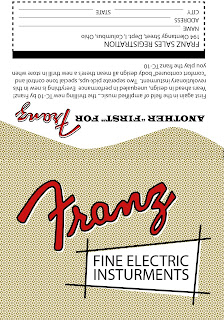
I gave a long lab assignment today that kept my students in the zone, I had time to research some old fender advertising from the 50s and 60s. It inspired me to create a registration card for my relic. It sparked an interesting discussion on the role of research in design with my students.

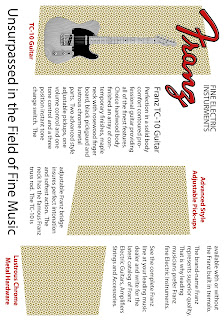
The card is designed to fold in the center, the first image is the exterior and the second is the interior. I used text from several cool old fender advertisements I found at relicdeluxe.com. Here’s what I came up with.

Exterior text:
Another “first” from Franz. First again in the field of amplified music… the thrilling new TC-10 by Franz! Years ahead in design, unequaled in performance. Everything is new in this revolutionary instrument. Two separate pick-ups, special tone control and “comfort contoured” body design all mean there’s a new thrill in store when you play the Franz TC-10.

Interior text:
Franz TC-10 Guitar Perfection in a solid body comfort contoured professional guitar providing all of the finest features. Choice hardwood body finished in an array of contemporary colors. Maple neck with rosewood finger board, black pick guard and lustrous chrome metal parts. Two advanced style adjustable pick-ups, one volume and one tone control and a three position instant tone change switch. The adjustable Franz bridge insures perfect intonation and the softest action. The neck has the famous Franz truss rod. The TC-10 is available with or without the Franz built in tremolo. The brand-name Franz represents superior quality. That is why leading musicians prefer Franz fine electric instruments. See the complete Franz line at your leading music dealer and write for the latest catalog of Franz Electric Guitars, Amplifiers, Strings, and Accessories.

Here’s what I developed, its a work in progress. I’m going to use the exterior halftone pattern on the interior gold panels, I’ll also add images of hardware in the panels.
Improvised Paint Booth

I was having a hard time finding an appropriate place to spray the body and neck. I ended up lining part of the crawl space about my studio with visquene and stapling a furnace air filter over a vent, not sure if that will do anything but it seemed like a good idea. I emptied a can of old clear coat on the surrounding surfaces thinking that the aerosol will hold down dust particles in the space. With a large fan running in the room below I’m getting decent ventilation without kicking up much particulate matter. I’ll see how good this is when I start with color.

Thinking safety I invested in a good quality respirator and I always wear eye protection. I shot 3 thin coats of valspar primer (over 8 hours) on the body with good results. I then masked the neck and shot two coast of sanding sealer on the headstock, the results blended nicely with the existing finish on the neck.

Here’s the primed body

Here’s a shot of the newly sealed headstock. I had a hard time getting the contour on the back of the headstock where I wanted it.

Stage Makeup

Here are photos of the completed hardware, other that cutting down the screws that adjust intonation. I’m very happy with results. The level of crime and corruption is well beyond most of the vintage instruments I’ve seen. After I had completed my first round of etching and rusting I think I did a pretty good job of creating an accurate amount of deterioration, given the type of chrome on the saga (reference the photo on my 4.3 post).

I showed the results to my wife and she couldn’t tell I’d done anything at all. Granted shes not technical and cant tell the difference between a Les Paul from a Strat, but it made me rethink the effect I was going for. Ultimately I want “stage makeup” not tiny the nuances that only a vintage buff will really understand, I’ll save that effect for another guitar. So it was back to the etching bath for another round. I ended up with the “wrapped in an army blanket and left in the corner of the garage behind old wooden shutters and forgotten for 50 years” look.

A few note on process: After re-etching I did a short rust bath (about 2 hrs) I ended buffing most of that effect off with the exception of the tuner covers, I liked the green cast they picked up. I rubbed black shoe polish into the chrome, it caught in the corners and pitted areas and added a slight layer of grime. Before I reassembly I hit the parts with a layer of clear coat.

For the pickup a used an exacto and carefully scuffed the edges and took a few small bites out the edges with end cutters and then back to the exacto to soften the cut edges. I also used a little brown oil pastel near the magnets to simulate rust.

A Quick Cut


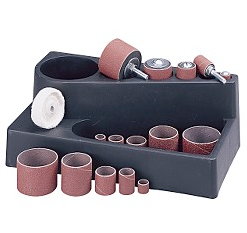
We had a wonderfully warm day so I ventured out to my shop and cut the headstock down to shape. I smoothed the profile with the new drum sander kit attached to my drill press. It worked nicely.

I shaped the headstock from a telecaster CAD drawing, the position of the tuners is a little off releative to a real tele but I think it will work fine on the Saga. I’ll post the file if anyone is interested.

Etching Day

I decided to start with the larger pieces to establish the amount of material. I wanted to chew through. I used a solution of 50% water and 50% etchant and submerged the bridge and control plate for three minute intervals. Between each dip I rinsed in water and used a paper towel to rub away the corroded remnants on the surface of the metal. I ended up etching for around 20 minutes. The result was slightly pitted with a nice dull reddish brown tone.

After drying the parts I applied the rusting liquid and let it sit for about an hour. The result left a very green surface on the metal but when this was buffed away it darkened the the finish slightly and slightly broke down lines of scratches in the metal.

I repeated the process with the smaller hardware. My biggest concern were the small threads on the bridge so I held back the small stuff and I put a bead of hot melt glue through the threaded parts of the bridge saddles. I’ll boil the glue out after etching.

I separated the hardware into surface area similar batches and used a couple of glass jars and etched the parts in bulk. After the water wash I dried the parts and gave them a shot of wd-40. I may “rust” a few more of these before assembling later.

The last step of the day was to apply black shoe polish on the big parts to decrease the contrast in the finish a bit.

Heres a pic mid rust, I’ll post photos of the completed hardware once I have the bridge and control plate back together.

Round and Round

I made a sketch of the tuners and then broke them down so I could start the hardware relic process. I placed all of the small hardware into a small rock tumbler with a handful of stones and let it bounce around for about two hours. Unfortunately the control plate wouldn’t fit so it looks like I’ll be doing that one manually with a coffee can.

I did a test on the body of the shown tuner with etchant and it knocked the shine off rather well, compare it to the shiny but scuffed appearance on the top of the peg. The green cast on the bridge and the side of the tuner is from a computer monitor. Click on the image above for a BIG view.

As my research has continued I found a wonderful site relicdeluxe.com This site is indispensable for creating a relic instrument.

Teardown

After everything was together and working correctly I started the process of tearing it back apart. I re tasked a flip top plastic organizer to keep all of the hardware organized and dissembled to individual components.

Thinking ahead to reshaping the headstock, I picked up a 21pc drum sanding kit at sears hardware for 15.99.


T
he next step will be to start adding about 50 years of wear to the metal hardware.