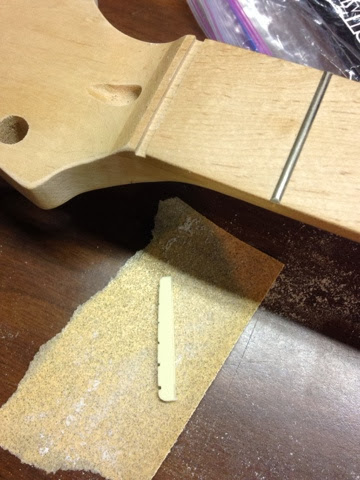
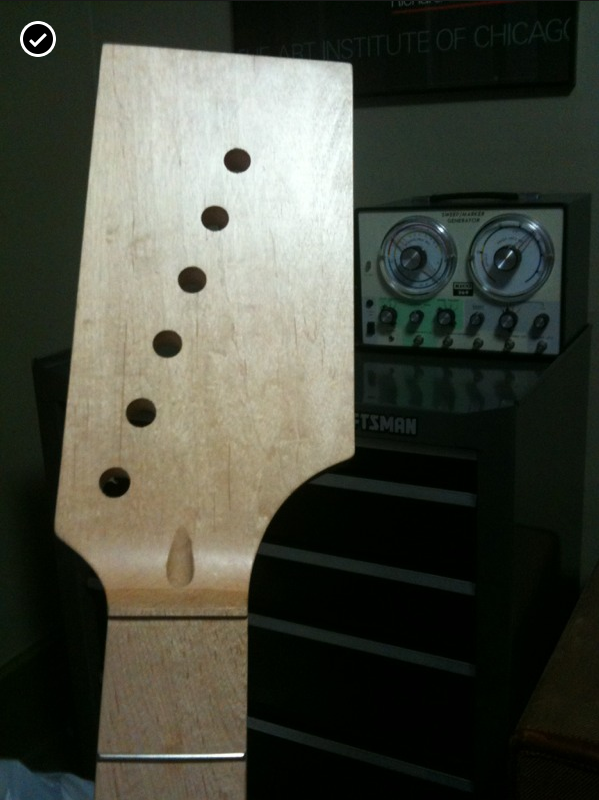
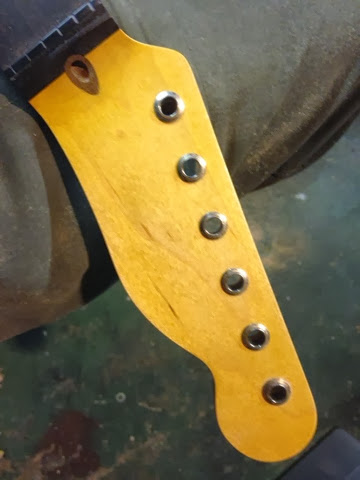
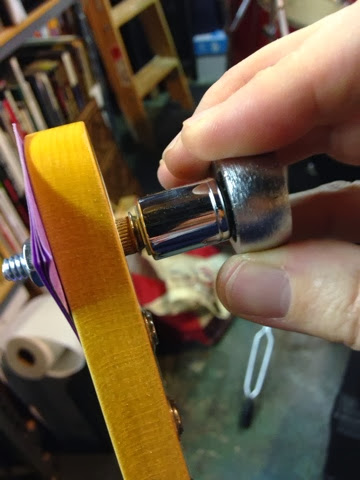
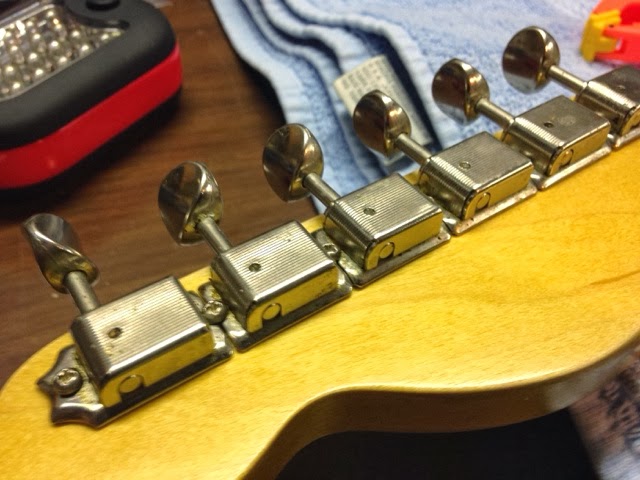
Can’t wait to shoot the body. I love the 50s profile neck.
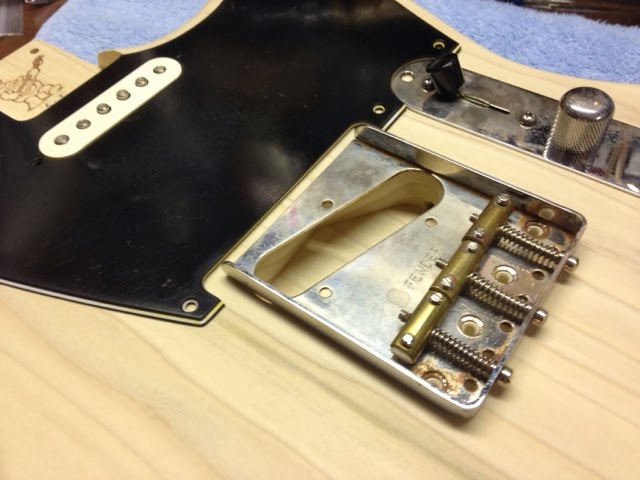
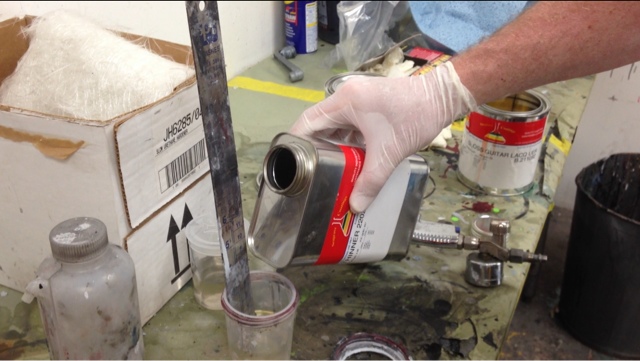
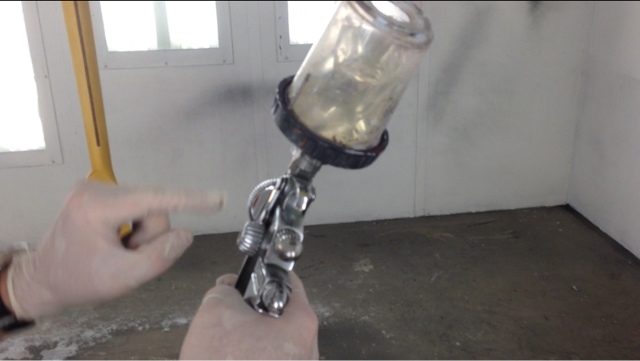
Mr. Cross spreading the good word. About 8 minutes to flash between coats.
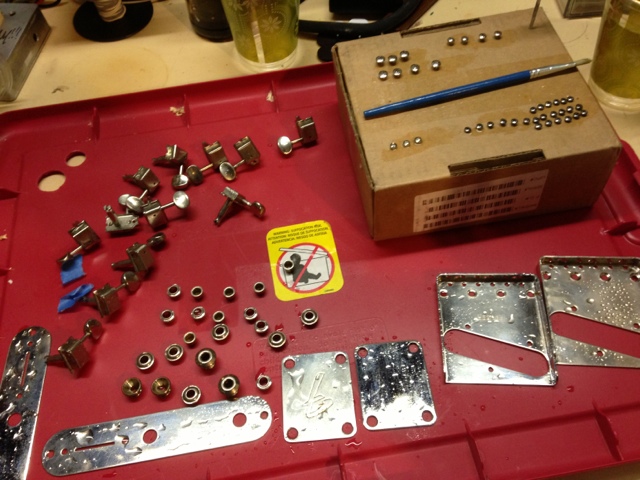
Testing stew Mac vintage amber on the heel of the neck

From http://paulblow.tripod.com/pdb-resources.html
When listening to music, nothing gets me going like a slammin’ drum sound. Many engineers and producers (myself included) actually believe that the snare drum sound is more important than even the lead vocal on a record! Let’s face it, nothing ruins the sound of a great band like weak sounding drums. If you play rock, metal, punk, etc. – you want a slammin’ snare that hits you right in the gut with each hit- you want a kick drum that packs a whallop! Now, how can you record slammin’ drum tracks in your home studio? Here’s how it’s done…
the Snare – The snare is the most important part of the drumset. If I can only hear one piece, it’s got to be the snare. The pros all agree that the best way to capture a great snare sound is by close-miking it with a dynamic, cardiod-pattern mic. The legendary SM-57 is an excellent mic for the snare, it is the choice of many professional engineers, and it’s what I use myself.
The classic approach for miking the snare is to place the mic 1-2 inches over the snare rim opposite the drummer and one inch above the top drum head. The mic should be at about a 35 degree angle downward. I usually try to also angle the mic inward (away from the hi-hats) to avoid leakage from the hi-hats. If you are recording to magnetic tape, hit the tape hard and you’ll get some nice analog compression from the tape saturation. If you’re recording to a digital medium, you should compress the snare to avoid any digital clipping.
Some engineers also mic the bottom snare head for some added snap, but I’ve never been a fan of this technique. Everytime I’ve recorded the bottom snare, I usually haven’t used it in the mix.
the Kick drum – For the kick drum, you should use a dynamic mic – the bigger the diaphram, the better. I’ve used RE-20’s (the famous radio mic) with great success, but when I’m recording drums at home I’ve used an Audio-technics dynamic mic (actually a vocal/all purpose mic), and also an SM-57, which delivers a nice punchy kick sound.
The way I usually mic a kick drum is to stick the mic inside the kick drum (I always remove the front head) about 3-4 inches in front of the beater. That’s a good place to start – you can move the mic around and find the best sounding spot. I usually stick a pillow or blankets against the rear drum head to minimize rings and to improve the thud factor. You’ll get more thud the closer the mic is to the beater – you’ll get more overtones farther away.
Toms – If you’ve got enough mics, it’s best to mic each tom separately and run the tom tracks to a submix (panning them accordingly). Again, dynamic mics work the best, and SM-57’s once again are a top choice. Sennheiser 421’s also are a great tom mic, but they are expensive.
The best approach to miking toms is to place the mic 4-6 inches above the drum head at about a 45-degree angle over the head. If you pick up a lot of overtones, a little duct tape in the right spots will kill the overtones, or if you have a noise gate you can gate out the overtones. I always move the mics around a little at a time until I find the right spot/angle that picks up the tom sound the best.
Overheads – The drum overhead mics are really supposed to capture the overall sound of the drums, not just the cymbals. Condenser mics are the first choice for overheads, and one popular miking technique is with a spaced pair of mics (on boom stands) mounted 3 feet above the drums -the right mic pointed at the right cymbals, the left mic pointed at the left cymbals. Another technique is called X-Y miking, and the two mics are placed above the drums with their capsules one inch from each other – with the right mic angled down toward the left side of the set, and the left mic pointed down to the right of the set. The mics should actually form a 90 degree angle together (I wish I could draw a picture here.)
Hi-hats – If you’ve got enough mics and tracks, you can always mic the high-hat. I’ve always used a small condenser mic placed about a foot above the high-hats, pointed straight down at the center of the top hat. Of course, when recording drums you will have plenty of leakage, and miking the hats are not really necessary.
Recording drums with 4-mics – I’ve often recorded drum tracks at home using just four mics, with very nice results. I always mic the kick and the snare, and I use two overhead mics to capture the toms and cymbals (as well as the overall drum sound.) The trick is to set the two overheads in the right spots so that the cymbals and toms will be recorded with a decent mix. I prefer my cymbals to be in the background in my mixes, so I try to make sure that the overheads pick up the toms loud and clear with the cymbals behind them (crisp, not muffled).
Recording drums with a stereo pair – If you’ve only got a couple mics, or very few tracks to play with, try this: Place a pair of SM-57’s 10 feet in front of the drumset, 3 feet high, 3-4 feet from each other pointed straight at the drum set. You can actually get a pretty good sounding recording with this method, especially if you’ve got a nice live room to record in. Adding some compression really gives it some balls, too.
That’s all I have for now… so rock out! One of my best sources for audio recording has always been the book Sound Advice -the Musicians Guide to the Recording Studio by Wayne Wadhams, which was one of my text books in my Audio Engineering classes. This book is written so even musicians can understand, and has a wealth of tips on recording (I mentioned a couple of them here)- in fact it’s the best book on the subject I’ve found! I highly recommend it.
Nady SCM 900 condensor mic
Now that you’ve got a good assortment of dynamic mics (the SM-57 and SM-58), all you really need for your home studio is a nice large diaphragm condensor microphone, and you DON’T have to spend $1000 on a Neuman! The Nady SCM 900condensor microphone is one incredible deal, you can get one of these bad boys for only $59.99. Don’t let the low price fool you, these are high-quality sounding and not cheaply made at all. The SCM 900 is a cardioid pattern large diaphragm microphone made for recording studio vocals and acoustic instruments. The mic features a one-inch gold-sputtered diaphragm, has a frequency range of 30-20,000 Hz, and comes in a nice carrying case.
I bought mine a many years ago because I already had a slew of SM-57’s and SM-58’s in my mic arsenal but I wanted to add a condensor mic to my collection for recording acoustic guitar and vocals, and the Nady SCM fit right into my tightwad budget. That’s right — I actually ordered this mic because it looked cool and was the cheapest studio condensor mic in the catalog on sale! I do all my home recording digitally either on my ADAT or straight into my computer’s multi-track programs, and I must say, I was SUPER impressed the first time I used it to record some vocal tracks. The sound is so much fuller, crisper and cleaner–plus it gets a hotter signal–than the SM-58 I used to use for vocals. Not a big difference, either, a HUGE difference. And for recording voice overs, yeah… it has that “FM radio” sound. For recording acoustic guitar the results were the same: AWESOME sounding, full, crisp and clear, with very little eq’ing necessary at all. A huge improvement over the SM57 I used to use to record acoustic guitar. I’ve also used this mic for drum overheads, and the cymbals came through shimmering and clear, very nice sounding, again a big improvement over the SM-57s I had always used before. I haven’t tried this on a grand piano yet, but I imagine with two of these mics spread out the results would be beautiful. The SCM 900 is a very full-sounding mic with fantastic lows, shimmering highs, a lot of depth and clarity. I’ve also tried recording my Marshall half-stack with this mic, but it sounded very boxy, so I’m sticking with the SM-57 for electric instruments. But for acoustic instruments and vocals/voiceovers this mic really delivers the goods.
The SCM 900 is 48V phantom powered, so you will to have to have a soundboard with phantom power. This mic is also super-sensitive so you will definitely need a shock mount for it… without a shock mount this mic will pick up any little sound or vibration — if you tap your foot on the floor it will pick it up, if someone shuts a door in the next room it will pick it up. A pop filter for recording vocals is also highly recommended. With the pop filter and shock mount you’ll be set for high-quality studio recording.
There are many other large diaphragm condensor microphones on the market for under $100. I also own a Marshall V57M large diaphragm condensor mic which was more expensive than the Nady SCM, but the Marshall mic sounds boxy compared to Nady. I very highly recommend the Nady mic for anyone with a home recording studio who does vocals or acoustic instrument recording and is on a budget.
If for any reason you find yourself with random missing tracks, (or are trying to recover from a dying hard drive like me), there is an easy way to isolate those missing tracks.
1. Create a standard playlist called “Not Missing”. Voila! All your missing tracks with the dreaded exclamation mark are now in a playlist. You have three options: |